
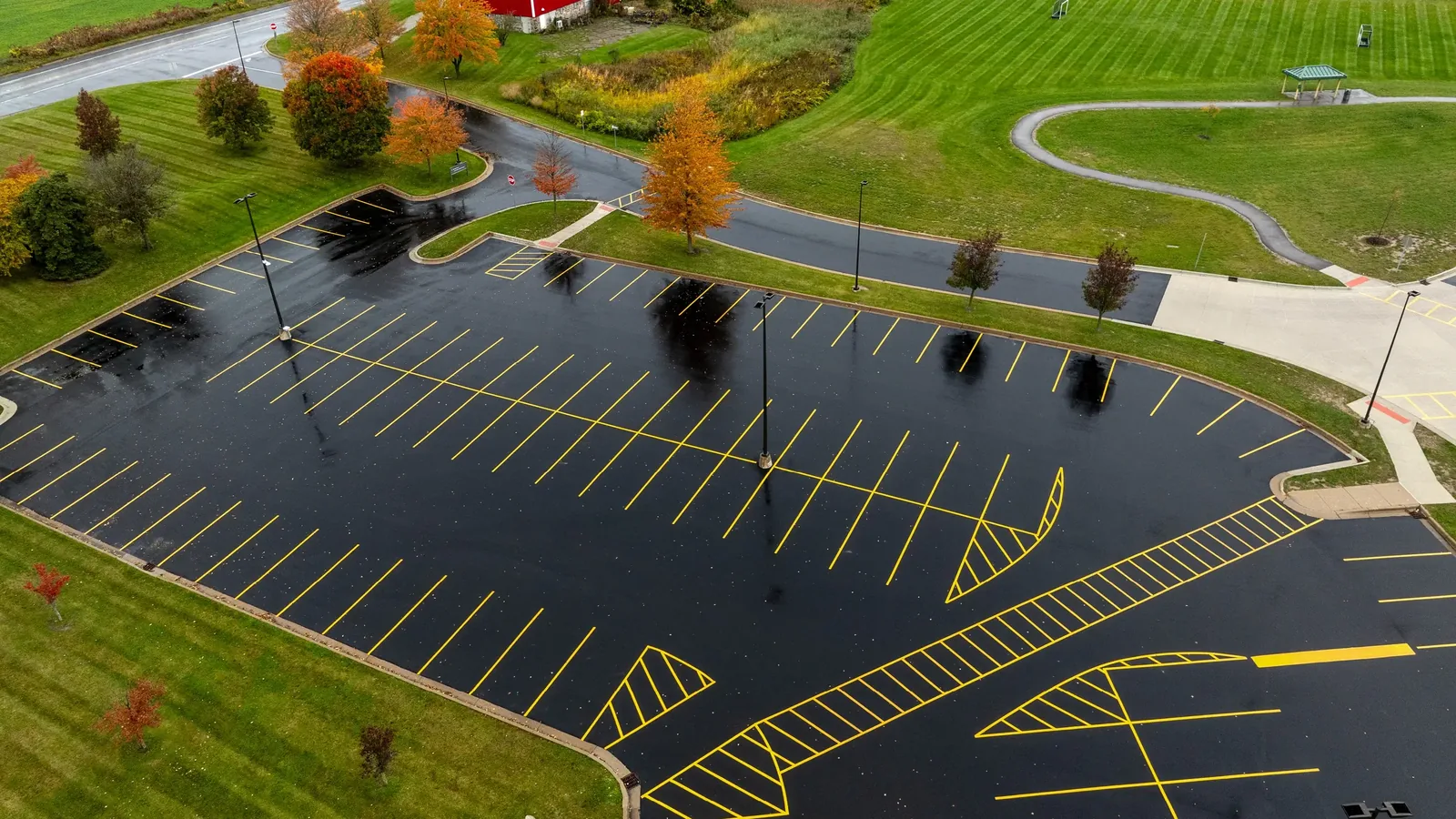
What Does ADA Require When You Stripe a Parking Lot in Alabama?
Stripe or restripe a lot in Alabama and the accessible spaces have to meet the 2010 ADA Standards. A lot with 1 to 25 spaces needs at least one accessible space. A lot with 100 spaces needs four. One in every six accessible spaces, or fraction of six, has to be a van space.
The Justice Department says it plainly. Restripe the parking spaces and you must provide accessible spaces that meet the 2010 Standards. Alabama law adds the enforcement side, with minimum fines that start at $50.
How many accessible spaces does the lot need?
The count comes off Table 208.2 of the 2010 ADA Standards. It is figured for each parking facility on its own, not for every lot on the site. Van spaces come out of that same number at one in every six.
| Total spaces in the lot | Accessible spaces | Of those, van accessible |
|---|---|---|
| 1 to 25 | 1 | 1 |
| 26 to 50 | 2 | 1 |
| 51 to 75 | 3 | 1 |
| 76 to 100 | 4 | 1 |
| 101 to 150 | 5 | 1 |
| 151 to 200 | 6 | 1 |
| 201 to 300 | 7 | 2 |
| 301 to 400 | 8 | 2 |
| 401 to 500 | 9 | 2 |
| 501 to 1,000 | 2 percent of the total | 1 of every 6 |
| 1,001 and over | 20, plus 1 for each 100 over 1,000 | 1 of every 6 |
Hospital outpatient, rehabilitation and residential parking run on separate rules in sections 208.2.1 through 208.2.3. A store, office, church or school lot uses the table above. The count is the first thing laid out on a parking lot striping job.
How wide do the spaces, aisles and signs have to be?
A car accessible space is 96 inches wide at a minimum. A van space is 132 inches. It may drop to 96 inches when the access aisle beside it is 96 inches. The aisle itself is 60 inches wide at a minimum, and it runs the full length of the space it serves. Two spaces may share one aisle.
Three more rules decide whether the lot passes. The aisle has to be marked so drivers do not park in it. Spaces and aisles have to sit nearly flat, with no slope steeper than 1:48 in any direction. Van spaces and their aisles need 98 inches of vertical clearance.
That slope limit is where lots fail. The Asphalt Institute wants 2 percent of slope or more to drain a lot, and 1:48 works out to about 2.08 percent. The grade under those stalls has to be right before any paint goes down. That makes it part of the paving, so it belongs in the layout for a new parking lot.
Signs carry the International Symbol of Accessibility. They sit 60 inches above the ground at a minimum, measured to the bottom of the sign. Van signs add the words “van accessible”. A site with four or fewer spaces needs no such sign. Its one accessible space still has to be van accessible. Accessible spaces go on the shortest accessible route to the entrance.
Does restriping an old lot trigger the rules?
Yes. Justice Department guidance is direct on this point. A business or a government that restripes its parking spaces must provide accessible spaces to the 2010 Standards. Businesses open to the public also carry a continuing duty to remove parking barriers where it is readily achievable. Because restriping is relatively inexpensive, the guidance says it usually is.
So the blank lot after sealcoating or a repair is the moment to fix the count, the aisle widths and the slope. Painting the old layout back onto a lot that was short an aisle keeps the problem for another two years.
What does Alabama law add?
Alabama’s disability parking rules sit in Code of Alabama sections 32-6-232, 32-6-233 and 32-6-233.1. Section 32-6-233.1 makes it unlawful to park in a designated disability space without a plate or placard. It reaches any place of public accommodation and any other place the general public is invited, even though located on private property. That sentence covers a store, a clinic or a church lot.
The fines are minimums and they climb: $50 for a first offense, $200 for a second, $500 for a third or later. A second or later offense also carries a court order for at least 40 hours of community service. Subsection (b) lets any authorized municipal, county or state officer go onto private property to enforce it. An amendment effective October 1, 2026 restructures the section and keeps those same minimums.
Those are the state’s fine amounts, quoted as law. They are not a price for any work.
Alabama allows, but does not require, the first offense fine amount on the sign or attached to it. Section 32-6-232 also says accessible parking places shall comply with ANSI A117.1 (1980). Ask your building official which standard your project gets reviewed against. Placard misuse is handled separately in section 32-6-233, as a Class B misdemeanor.
What does restriping a parking lot cost?
These are market numbers from national cost guides, not our price list. Those guides put a striping project at $500 to $1,000, with an average near $750. Per square foot they put a plain restripe at $0.06 to $0.16. Cross hatching and accessibility zones run to $0.25.
| Item | Published market range |
|---|---|
| Single stall line (18 ft) | $5 to $20 |
| Accessible parking stall | $25 to $50 |
| Stop bar | $10 to $30 |
| Crosswalk | $50 to $100 |
| Fire lane or loading zone | $25 to $75 |
| Curb painting | $1 to $4 per linear foot |
| Wheel stops or bumper blocks | $40 to $100 each |
| Mobilization or call out fee | $150 to $350 |
Alabama has a public price anchor too. ALDOT’s June 2026 bid tabulation shows traffic control markings bid at $2.50 per square foot in paint. Thermoplastic markings bid at $4.31 to $5.85. Those are state highway prices carrying highway overhead, so read them as direction.
How often does a parking lot get restriped?
No standard sets a calendar for a private lot, so paint life drives it. Public agency guidance puts water based traffic paint at about one year, and in some cases two, under normal road conditions. Thermoplastic lasts several years. Cost guides land in the same window, roughly 12 to 24 months.
The practical trigger is the one you can see from the door. When drivers start making their own rows, the lot is past due. Tying the restripe to the next sealcoat keeps it to one visit. Our guide to how often sealer goes back down covers that schedule.
How long does new asphalt wait before paint?
The pavement is not the holdup. The Asphalt Institute states that asphalt does not have a cure time. A new surface can carry traffic minutes after construction in most cases.
Permanent markings are a separate question. ALDOT Section 701 has asphalt cure 14 calendar days before Class 1H high build paint or Class 2 thermoplastic is applied. Class 1H is for state maintenance work only, so a private lot is not held to it. It is still the clearest cure number Alabama publishes. ALDOT also keeps high build paint off wet pavement and out of rain. It calls for a pavement temperature of 45 degrees and rising.
Temperature rarely stops work down here. Rain does. Mobile averages 66.15 inches a year on the 1991 to 2020 normals.
Getting your lot laid out
A faded lot, a missing access aisle and a stall count that never matched the table all get fixed on the same visit. We stripe new layouts and restripe worn lots for businesses, churches, schools and apartments. We work from Grove Hill down to Mobile, Baldwin County and the Gulf Coast.
Send the lot size and the stall count, and we come out, measure it and give you a written quote for striping. Call or text (251) 589-9970.